
Comparison from Sunsurf Solar
Floating or ground-mounted solar — what matters most?
A point-by-point comparison of floating solar (PowerModule™ on water) and conventional ground-mounted solar parks — drawn from live data across Sunsurf Solar's installations in Västra Götaland, Halland, Småland and Skåne. Last updated: 24 April 2026.
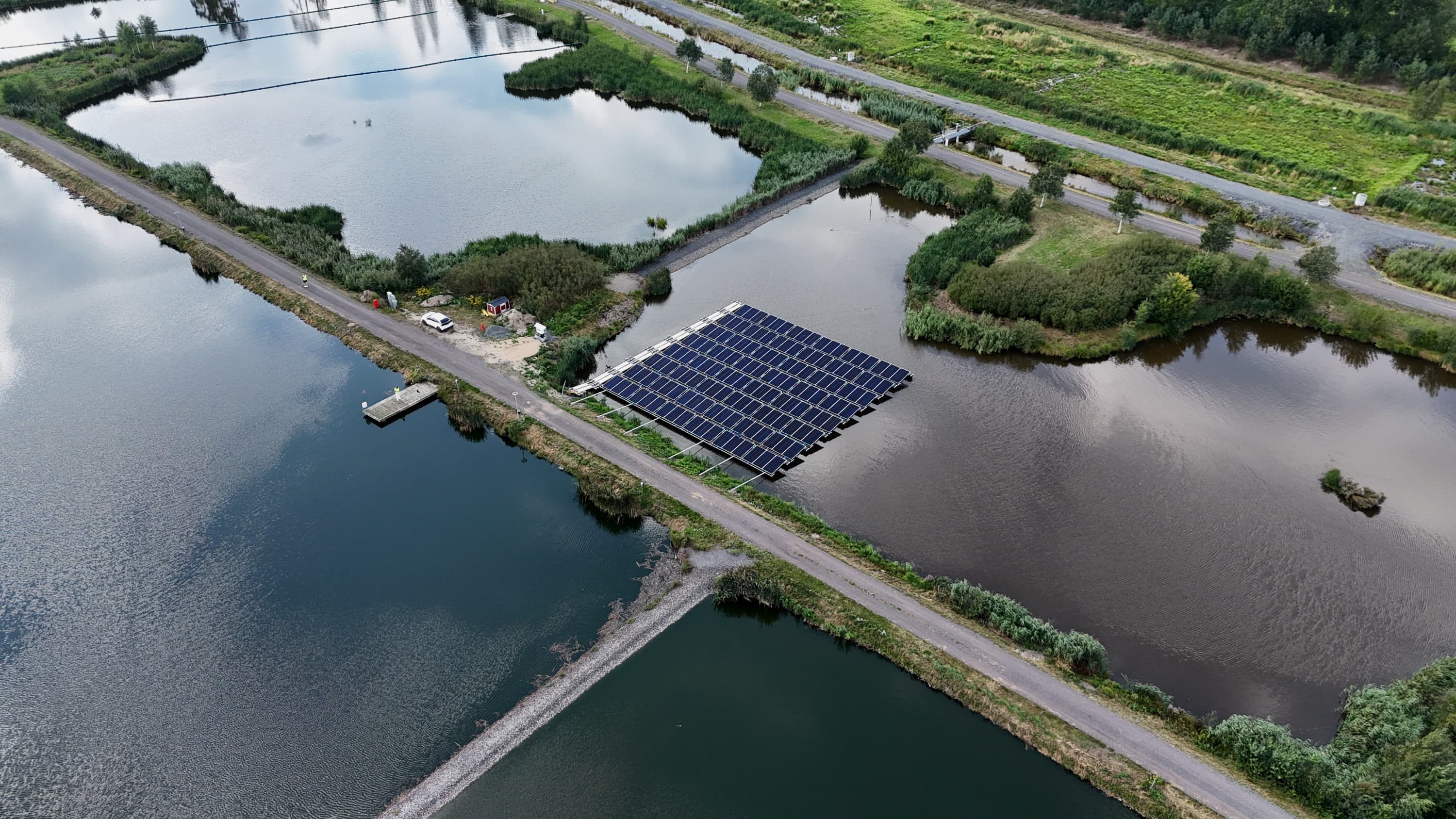
Nine criteria
Point by point — how the two systems differ
Both technologies produce renewable electricity, but under very different conditions. Here are the nine criteria where the differences weigh heaviest for Swedish and Nordic sites.
Land use
Zero land take.
Installed on an existing pond, reservoir or leachate pond — surfaces that cannot be used for cropping, grazing or forestry anyway.
0 ha land
Occupies productive land.
Ground-mounted solar parks compete with arable land, pasture or forest — often in direct conflict with agriculture and biodiversity.
Efficiency
Up to 15 % more output per kWp.
Natural water cooling and surface reflection give higher energy output than conventional ground-mounted monocrystalline panels at 25 °C.
+15 % at 25 °C
Efficiency baseline.
Performance falls as module temperatures rise above 25 °C in summer — without cooling, modules can easily reach 50–60 °C on a sunny day.
Evaporation
Reduces evaporation by up to 155 m³/year.
Covering the water surface limits evaporative loss — measured at Sweden's largest floating solar park in Jönköping (116.1 kWp).
155 m³/yr saved
No effect on water resources.
Ground-mounted systems neither save nor waste water — but they offer no secondary benefit for irrigation ponds or reservoirs either.
Installation
Fully pile-free installation.
PowerModule™ sits on HDPE pontoons and is anchored to shore with Sunsurf's FlexibleMooringSystem™ — leaving the pond floor and protective liners untouched.
Pile-free
Requires pile driving or foundations.
Conventional ground parks normally use driven steel piles or concrete foundations excavated into the soil — difficult or impossible on peatland, landfill or waterlogged ground.
Maintenance
Service via integrated walkways.
Each PowerModule™ has a walkway for safe access without boats or special equipment. The water surface does not generate airborne dust, so panels collect less particulate than ground-mounted systems.
Vehicle access from the ground.
Ground-mounted arrays are easily reached by service vehicles, which simplifies major work. Panels do collect more dust and pollen from the surrounding soil, however — and snow drift can linger longer on low-tilt rows.
Lifetime
40-year technical life on the mounting.
Aluminium, coated steel and HDPE are chosen for corrosion resistance in leachate, salinity and UV. Solar panels retain at least 80 % output after 25 years.
40 yr mounting
Ground foundations degrade over time.
Frost heave, erosion and ground movement cause settlement in foundations and may require re-levelling. Panel life is comparable (25–30 yrs); structures wear faster.
Ecosystem impact
Shades water — reduces algal blooms.
The open design lets light and oxygen through. Partial shading keeps the water cooler and can reduce nutrient-driven algal blooms in summer.
Affects soil flora and fauna.
Ground arrays seal or cover the surface, affecting soil organisms, flora and drainage. Shade beneath panels alters plant communities.
Thermal performance
Cooled passively by the water beneath.
Passive cooling counteracts the performance loss that occurs at high module temperatures — most valuable during the hottest summer hours when electricity prices peak.
Loses output in heat.
Without cooling, module temperatures rise 20–30 °C above ambient, reducing efficiency precisely during peak summer production hours.
Nordic climate
Eurocode + DNV-GL for floating systems.
Sunsurf Solar systems are engineered for Swedish snow, ice and wind loads. FlexibleMooringSystem™ accommodates water-level variation above 6 metres.
Proven — but sensitive to snow.
Conventional ground arrays are well-proven in the Nordics, but low-tilt systems collect snow that must be cleared to avoid losing winter output. Foundations must be sized for frost heave.
For ponds, reservoirs and leachate basins, floating solar wins on every measurable criterion — higher efficiency, water saved, no land take, longer lifetime. On drier terrain, ground-mounted solar remains relevant — but it should not occupy productive farmland while existing water surfaces sit unused.
Want to know which technology fits your site?
Send us a site or a pond — we typically reply within two working days with an initial assessment.
See PowerModule™Buy the system or sign a PPA?
Compare ownership against Power as a Service — and read about the permitting process for floating solar in Sweden.
Permitting guide